What You Say Matters More Than You Think

Substance use disorder is a chronic medical condition, but the language surrounding it often tells a different story. This campaign encourages everyone, from providers to the public, to consider how the words we choose can reduce stigma, promote understanding, and support compassionate care.
Watch: The Same Door
What is stigma and why does it show up in health care?
Stigma happens when people see a label before they see a person.
In clinical settings, it usually looks like this: substance use disorder gets treated as a choice or a moral failing instead of the chronic medical condition it is.
And it’s common! A systematic review of 32 studies found that stigmatizing attitudes toward patients with substance use disorders are widespread among healthcare professionals and trainees.¹ Half of those studies were published in 2020 or later, suggesting this remains an active and unresolved problem.
Patients notice. In an ADAI survey of people who use syringe services programs (SSPs) in Washington State2, many participants said supportive, respectful interactions with staff were one of the most valuable parts of the program. For many, SSPs were the only place they weren’t judged, and that sense of acceptance made them more willing to return and seek additional support, including treatment.
Am I biased?
Most people don’t think they’re biased – that’s how bias works! Implicit biases operate outside our conscious awareness, and people who consciously reject prejudice can still show biased patterns in perception or behavior.
Bias isn’t a character flaw. It’s a pattern in how our minds make quick assumptions, often without us realizing it. Those assumptions shape how we speak, listen, and respond, even when our intentions are good.
Learning about stigma is an important first step. But lasting change doesn’t come from a single training or a new list of words. It comes from continuing to notice our assumptions, reflect on them, and practice something different.
Awareness is where change starts, not where it ends.
How does stigma impact healthcare?
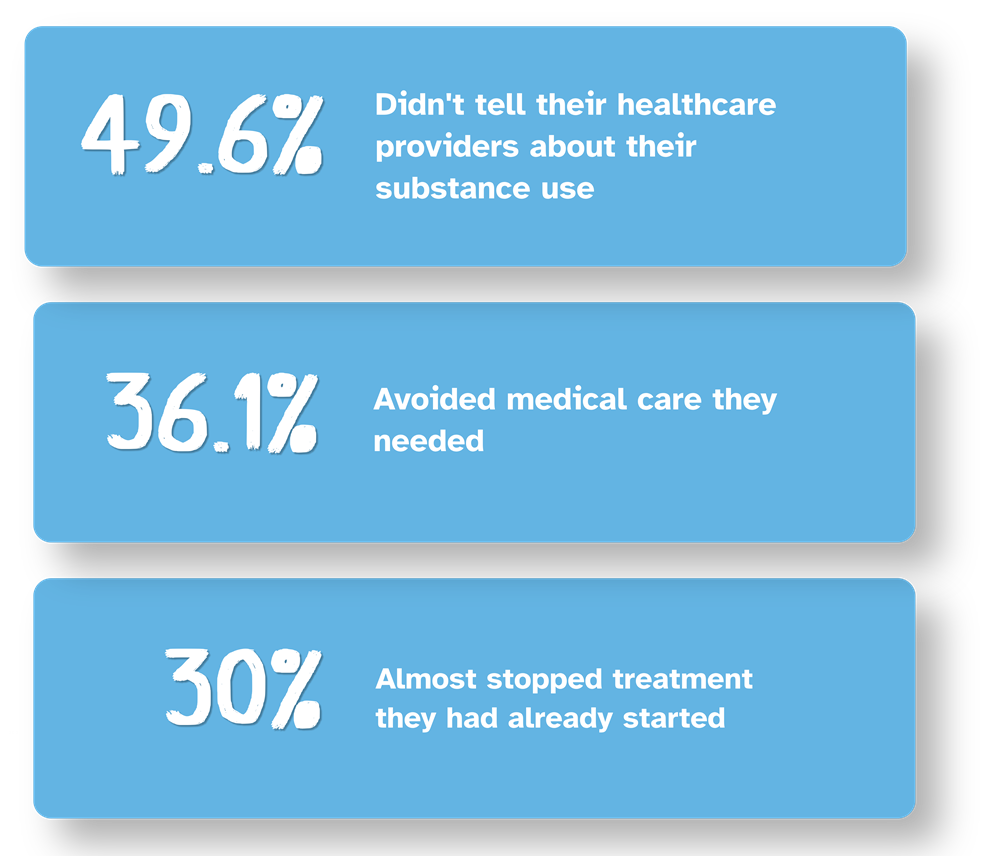
In a survey of adults with SUD3:
Words to reconsider
| Instead of | Try | Because |
|---|---|---|
| Addict, abuser, user | Person with a substance use disorder | Labels like this define someone by their condition instead of recognizing them as a person. Person-first language helps reduce stigmatizing attitudes that can negatively impact care. |
| Clean / dirty urine | Positive or negative for [substance] | Lab results describe chemistry. They don’t describe a person’s worth. |
| Non-compliant | Treatment isn’t working for them yet | Moves the question from blame to problem-solving. |
| Habit | Substance use disorder | Names the chronic medical condition the science describes. |
| Frequent flyer | Patient with repeat visits | Repeat visits are a signal about the system, not a character trait. |
| Drug-seeker | Patient requesting medication (for pain, anxiety, etc.) | Assumes a person’s motives rather than describing what’s actually happen. |
| Adapted from the CCSA/CAPSA language primer, Sundaram et al., and Febres-Cordero et al. | ||
Get the toolkit
Free to download, print copies of the factsheet and zine can be ordered via the ADAI Clearinghouse (for WA State residents only).
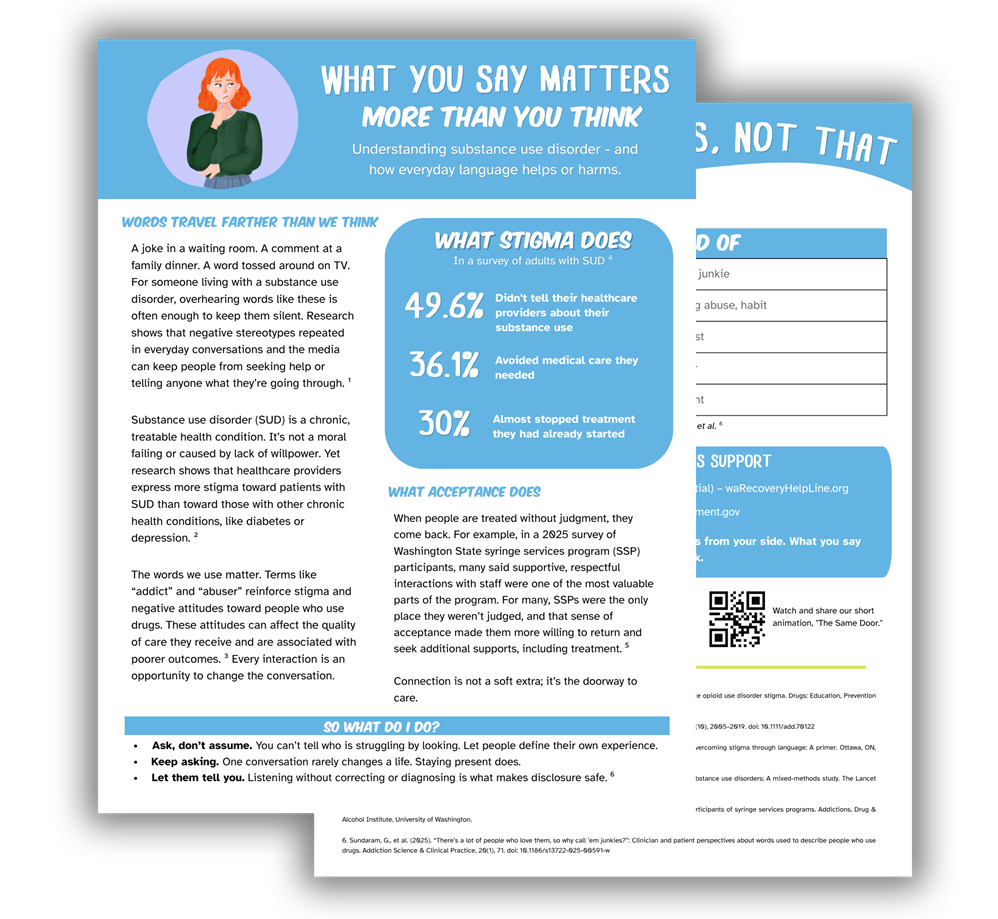
Fact sheet (2 pages)
For providers & healthcare staff: why words matter, what the research says about stigma and care, and a printable “say this, not that” guide.
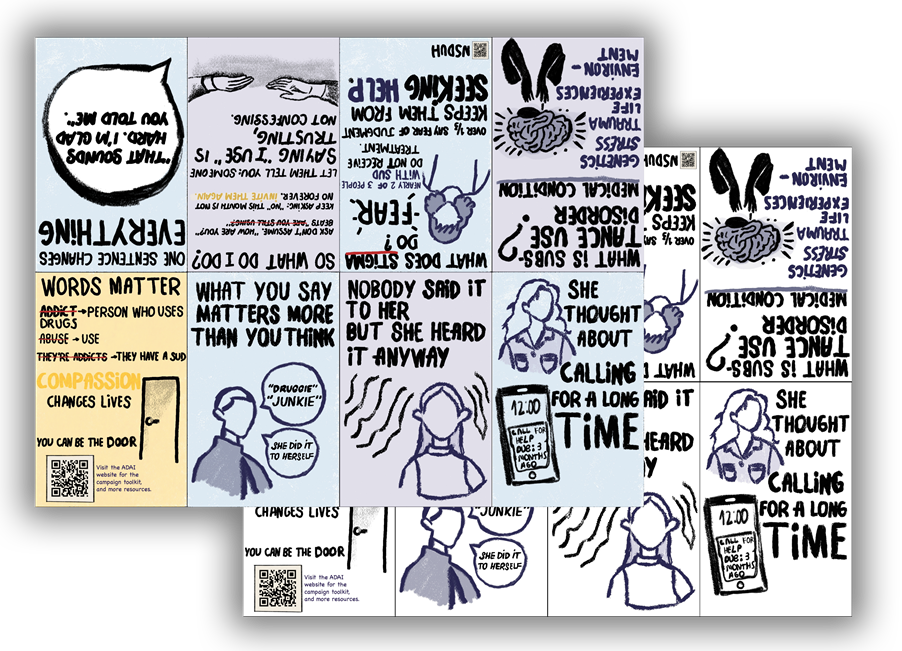
Community zine (8 pages)
For families, students, and community members: what to say when someone tells you about their substance use.
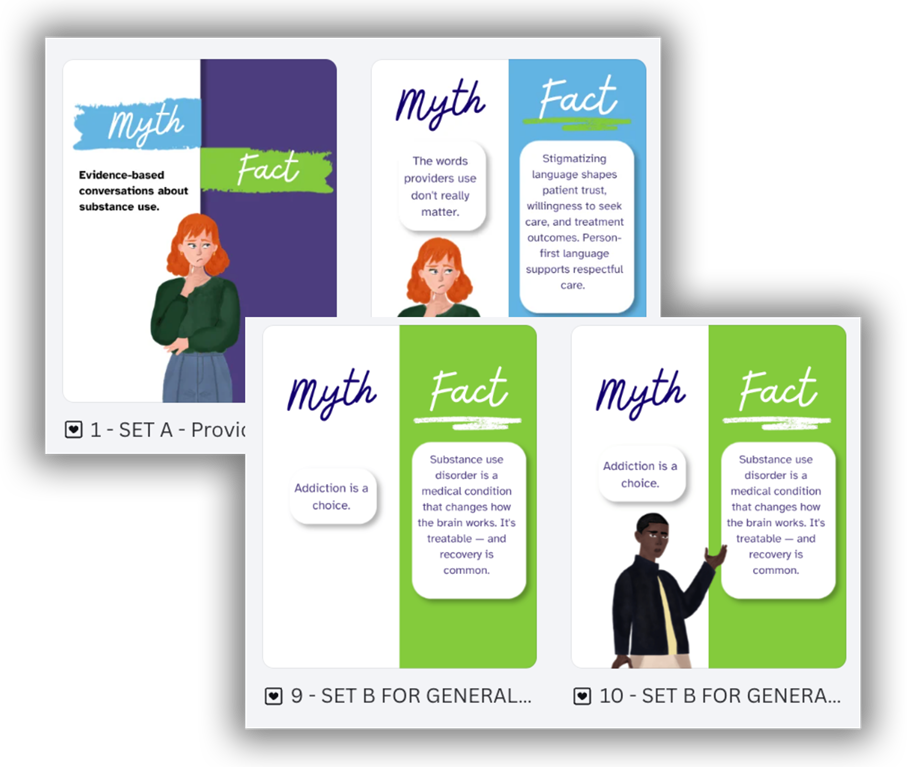
Myth vs. fact series
Sharable graphics for individual posts and carousels, multiple sizes and styles.

Animation: The Same Door
Lydia walks through the same door as everyone else. What she hears next is what’s different. A short animation on how everyday language opens or closes the pathway to care.
Resources from ADAI
- Empathy Lens Collection: Free, non-stigmatizing photos of substance use, harm reduction, treatment, and recovery.
- ADAI Clearinghouse: Free print and digital education and prevention materials for Washington State residents.
- Learn About Treatment: Resources for individuals, friends, and family of people with opioid use disorder.
- Treatment & Recovery Help: Helplines, self-help organizations, and local support.
- Washington State Data & Resources: Statewide and county-by-county resource listings.
- StopOverdose.org: Naloxone, fentanyl, and overdose response information for Washington State.
- Professional Tools: Screening instruments, evidence-based practices, and provider toolkits.
Campaign developed by Karen Da Silva, ADAI Information Services 2026 summer intern, with Meg Brunner, MLIS, and Erinn McGraw, BFA. Illustrations created in Adobe Fresco.