New ADAI Report Explores Smoking Supply Use and Impacts in Washington State
06/15/2026




From 2015 to 2025, Washington State saw a dramatic shift in opioid and stimulant use, with smoking replacing injecting as the primary route of administration among syringe services program clients. More than half of syringe services programs in the state now offer safer smoking supplies.
Safer Smoking Supplies – Use, Engagement, and Association with Decreasing Injecting in WA State, a new report from Alison Newman, MPH, and Caleb-Banta-Green, PhD, MPH, MSW, of ADAI’s Center for Community-Engaged Drug Education, Epidemiology & Research (CEDEER), explores smoking supply use and impacts based on the 2025 Syringe Services Program Client Survey.
It finds that:
- Smoking supplies are a key entry point to services: Nearly 60% of participants who began using the program in the past 5 years first came for smoking supplies. They also obtained other supplies, such as naloxone, and were just as interested in health and treatment services as other participants.
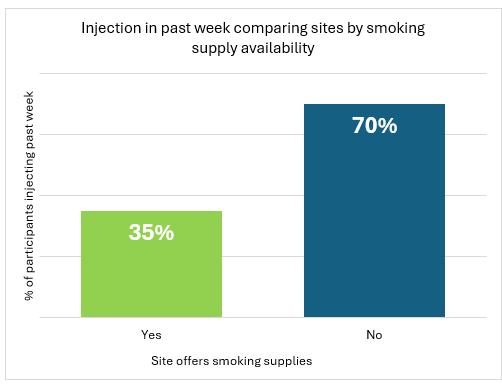
- Offering smoking supplies is associated with significantly lower rates of injection drug use: At sites that provide smoking supplies, 35% of participants reported injecting drugs, compared with 70% at sites that do not, a difference that isn’t explained by drug use patterns.
The brief concludes that smoking supplies bring in the majority of new clients (who are at high risk for overdose and infectious diseases), and they engage in and are interested in many other services and supplies. People who use drugs in communities that do not offer smoking supplies are twice as likely to inject, putting them at risk for infectious diseases such as HIV and HCV as well as serious wounds.