Safer Smoking Supplies – Use, Engagement, and Association with Decreased Injecting in Washington State
Alison Newman, MPH, and Caleb Banta-Green, PhD, MPH, MSW
Introduction
Use of supplies for smoking drugs, such as foil and pipes, is increasing. The funding, policy, and legal frameworks for these supplies varies by location and is in flux. Data from the Washington State 2025 Syringe Services Program Client Survey provide important insights into: usage rates for smoking supplies, the role of safer smoking supplies in engaging new clients, and their association with much lower rates of drug injecting.
Background
With the changing drug supply there has been a large shift from injecting to smoking drugs. Among 2025 survey respondents, 94% smoked fentanyl and 89% smoked methamphetamine. Conversely, among respondents to the 2015 survey, 99% injected heroin and 83% injected methamphetamine. Some respondents in both surveys reported both smoking and injecting.
See Distribution of Safer Drug Smoking Supplies as a Public Health Strategy for more about:
- What safer smoking supplies are
- Health benefits of smoking drugs & distributing smoking supplies
- Review of research evidence
Data: Smoking Supply Use, Interest, and Impacts
Smoking supply use, interest, and potential impacts on injecting:
- At sites that provide safer smoking supplies, almost all participants (89%) reported obtaining those supplies (1,262 participants at 13 programs).
- At sites that did not provide smoking supplies, 83% would “like to get free, clean pipes or foils to smoke opioids, cocaine, or meth” (432 participants at 11 programs).
- Of those who were interested in safer smoking supplies and injected, 75% said they would “inject less often” if smoking supplies were available.
Initial engagement for smoking supplies:
- A majority (59%) reported first using the program to get smoking supplies (among clients who initiated care in the previous 5 years).
- Clients who first engaged with the program to obtain smoking supplies also accessed other supplies (e.g., naloxone) and were as interested in health, mental health, and treatment services and reducing drug use as others.
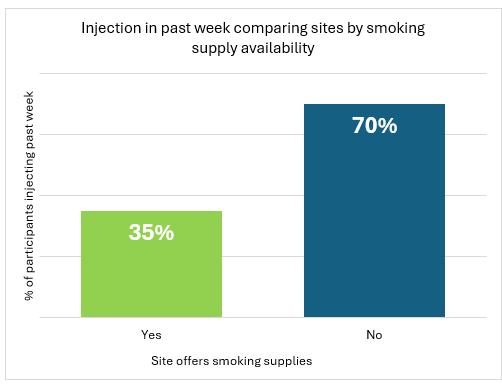
Injecting drugs was twice as prevalent in communities without smoking supplies (70% vs. 35%).
- While these data cannot prove cause and effect, this is a very large difference and a highly significant finding that cannot be explained by other factors, such as substances used or the prevalence of smoking drugs.
Conclusion
Smoking supplies bring in the majority of new clients (who are at high risk for overdose and infectious diseases), and they engage in and are interested in many other services and supplies. People who use drugs in communities that do not offer smoking supplies are twice as likely to inject drugs, putting them at risk for infectious diseases such as HIV and HCV, as well as serious wounds.
Citation: Newman A, Banta-Green C. Safer Smoking Supplies – Use, Engagement, and Association with Decreased Injecting in Washington State. Seattle, WA: Addictions, Drug & Alcohol Institute, Department of Psychiatry & Behavioral Sciences, School of Medicine, University of Washington, June 2026.