ADAI and Policy Initiatives
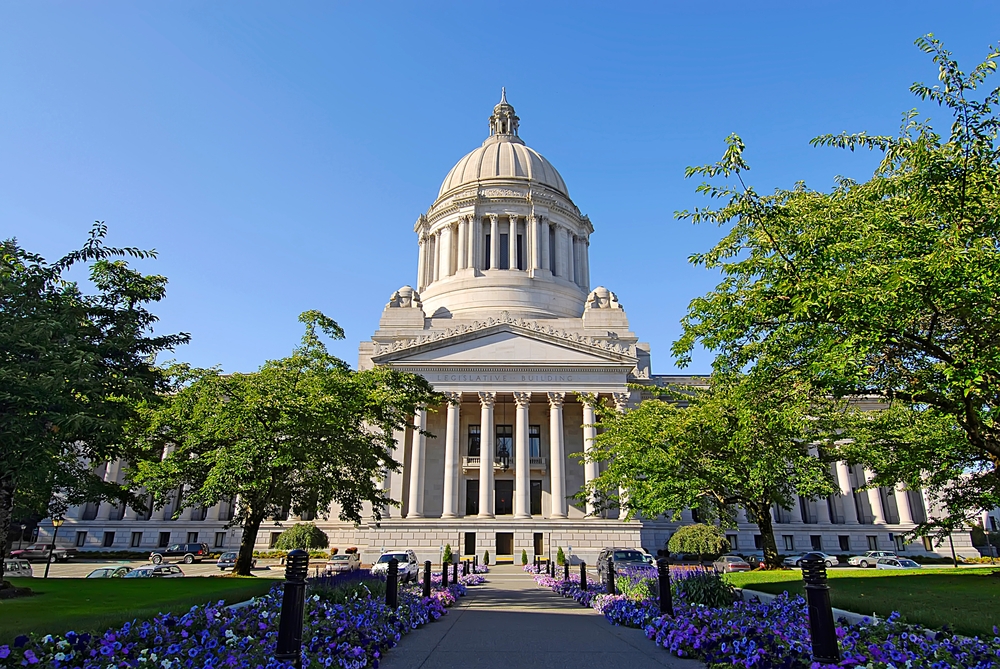
ADAI researchers and staff routinely respond to requests from policymakers and community partners to integrate subject matter expertise into policy development. This work can involve presenting at educational hearings, preparing policy and evidence briefs, one-on-one educational conversations with policy makers, and delivering testimony to legislators.
In these settings, ADAI experts share information about emerging issues, provide scientific evidence to guide health promotion and treatment strategies, and offer specialized knowledge on cannabis, opioids, stimulants, alcohol, and other substances.
Through these efforts, ADAI helps shape policies that advance public health and address real-world challenges.
Learn more about some of our policy work through the resources below. (Note: As state employees we follow all rules related to reporting any lobbying activities and coordinate policy related efforts with relevant UW government relations staff.)
On this page:
High-THC cannabis | Other cannabis | Health supports for people who use opioids and stimulants | Low-barrier health & treatment access for people who use opioids and stimulants | Treatment | Other work
High-THC cannabis
- Identifying policy options to regulate high potency cannabis: A multiple stakeholder concept mapping study in Washington State, USA (2024). Carlini BH, et al. International Journal of Drug Policy, 123, 104270. (article)
- Promising policies to reduce onset and progression of psychotic disorders in U.S. states with legal cannabis markets (2024). Carlini B. ADAI Symposium recording. (video)
- How should policymakers regulate the tetrahydrocannabinol content of cannabis products in a legal market [opinion]? (2023). Hall W, Leung J, Carlini BH. Addiction, 118(6), 998-1003. (article)
- High THC Policy Final Report to the Washington State Legislature: Exploring Policy Solutions to Address Public Health Challenges of High THC Products (2022). ADAI CERP team. (report)
- Regulatory considerations and challenges for cannabis products with high THC concentration (2022). Schauer G. ADAI Symposium recording. (video)
- How to address high THC cannabis products’ risks and harms: Perspectives of Washington stakeholders (2022). Carlini B. ADAI Symposium recording. (video)
- Cannabis Concentration and Health Risks: A Report for the Washington State Prevention Research Subcommittee (2020). PRSC Cannabis Concentration Workgroup. (report)
Other cannabis policy issues
- State requirements for non-medical US cannabis retail personnel (2024). LoParco CR, et al. Journal of Public Health Management & Practice, 30(4), 517-525.
- Assessing Engagement in Cannabis Policy: A Survey of Washington State Elected Officials (2025). ADAI CERP team: Kellum LB, Carlini BH, Garrett S.
- Marijuana policies: What matters for influencing public health (2016). Pacula R. ADAI Symposium recording.
- Marijuana legislation panel: Implementation challenges and opportunities (2016). Cooke M, Garza R, Baumgartner C, Ramirez R, Harris A. ADAI Symposium recording.
Health supports for people who use opioid and stimulants
- Improve Lives, Prevent Deaths: Guide for Community Organizations & Policymakers with Actionable Strategies for Preventing Overdose (2025). ADAI CEDEER team.
- CEDEER’s Dr. Caleb Banta-Green’s 2025 testimony at the WA State Legislature in support of HB 1574, protecting access to life-saving care and substance use services (2025).
- Safe Supply Work Group: Final Recommendations (2024).
- Policies, adaptations, and ongoing challenges to naloxone, buprenorphine and nonprescription syringe access across four-states: Findings from an environmental scan and key informant interviews (2024). Floyd AS, et al. Drug and Alcohol Dependence Reports, 11, 100243.
Low-barrier health & treatment access for people who use opioids and stimulants
- Press Release: Cantwell Introduces Bill to Take WA-Developed, Low-Barrier Fentanyl Treatment Pilot Program Nationwide (2024).
- U.S. drug-overdose legislation has roots at UW (2024). UW Medicine Newsroom (interview with CEDEER’s Dr. Banta-Green).
- Could WA’s health ‘hub’ model for opioid addiction go nationwide? (2024). Deng G. Washington State Standard.
Treatment
- Expanding access to medications for opioid use disorder: Federal policy is only a part of the solution [editorial] (2024). Heidari O & Banta-Green CJ. American Journal of Public Health, 114(7), 693-695)
- What most of us think about opioid treatment is wrong, researcher [Banta-Green] says (2023). Shapiro N. Seattle Times.
- Substance use is a health issue, not a legal one (2022). Banta-Green CJ. Seattle Times.
- Co-producing evidence-informed criminal legal re-entry policy with the community: an application of policy codesign (2022). Owens MD, et al. Evidence & Policy, 18(2), 365-375.
- Integrated Treatment Model: Specialized Treatment for Substance Abuse in Juvenile Rehabilitation: Report to the Washington State Department of Children, Youth & Families (2020). Stoner SA.
- Evidence-Based Practices in Washington State: A Report to the Division of Behavioral Health and Recovery, Washington State Department of Social and Health Services (2018). Stoner SA.
Other work
- Children are safer when families are supported – not separated [opinion] (2025). Stoner S. Seattle Times.
- Co-facilitation of the Washington State Treatment and Policy Workgroup
- Membership on committees including the Substance Use Recovery Services Advisory Committee