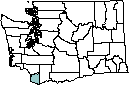
 seeing more than 1. Similarly, the 5 crime lab submisisons positive for morphine were associated with 4 counties, with only Lewis County
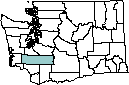 having 2.
Quarterly data provided by the Forensic Laboratory Services Bureau are used to identify drugs that appear to be increasing in law enforcement seizures in the 2 most recent quarters. (Data are preliminary and will change. For more on the data, see the details at the end of the page). We show significant increases in crime lab submissions associated with a given county (or the whole state) testing positive for a given drug. We define a “significant increase” or jump as a quarterly count more than twice as large as seen in the average quarter over the prior 3 years. We focus mainly on notable increases versus overall trends.
The number of cases positive for stimulants continued to increase post-Blake during the fourth quarter. The 42 cases of methamphetamine found in Spokane County so far in 2026 nearly equal the 47 such cases total observed in 2022 and 2023 combined.
Crime lab cases positive for cocaine in Chelan County in 2023: 9. Cocaine cases in Q1 2026, so far: 10
Updated Q4 data showed a notable increase in cases positive for MDMA with 23 cases statewide. Medetomidine cases continue to appear. Two older opioids, methadone and morphine also had increases statewide.
Due to experience with medetomidine on the East Coast, harm reduction and addiction medicine professionals in Washington have been preparing for the arrival of this strong sedative in the illicit fentanyl supply here. The King County Medical Examiner has reported a death involving medetomidine in 2024, but it was not seen in other data until being found in community drug checking samples in May of 2025. Medetomidine appeared in state crime lab data in Q3 2025. Q4 data indicate 8 cases statewide.
Methadone is typically used as a medication for opioid use disorder (MOUD) but can be prescribed for pain. Morphine is a lesser spotted, older opiate that is typically used for pain but can be used as an MOUD (more often in Canada). The 8 cases positive for methadone statewide were spread among 7 counties, with only Clark County seeing more than 1. Similarly, the 5 crime lab submisisons positive for morphine were associated with 4 counties, with only Lewis County having 2.
BTMPS is a relatively new adulterant associated with fentanyls. As it was essentially unheard of before the summer of 2024, most counts represent a jump over the prior 3 years' average.
Each of the cases positive for one or more fentanyls shown below was found to contain fentanyl itself. In addition, 2 cases in Spokane County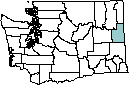 and 1 in Kitsap County
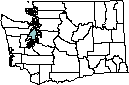 were positive for carfentanil.
The state saw 23 samples test positive for MDMA in the quarter.
King County may continues to see increases in cases sent to the state crime lab testing positive for meth.
Nine counties saw jumps in the number of cases positive for cocaine. The 12 cases in Benton County in Q4 2025 is equal to the total such cases for 2020, that last year before the Blake decision.
King County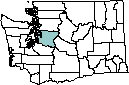 (5 cases) and Cowlitz County
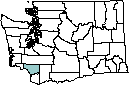 (2) saw jumps in cases positive for one or more tryptamines, a category that includes designer tryptamines such as DMT as well as LSD and psilocybin. One of the King County cases was positive for LSD and 4 for psilocybin. King County also had 5 cases positive for ketamine. Finally, although legal in the state of Washington, 8 counties saw increases in cases positive for cannabis in the quarter.
In the three years before the Blake decision, and after, two drug classes stood out for how often they have had increases: fentanyl and fentanyl analogues (or fentalogs). Although, as noted, quarter is a rough representation of time, we present time trends by quarter to illustrate the changes in the presence of these substances in Washington state. Click on the Fentanyl series name in the legend to turn that series off and better see the others. Due to recent concern, we have added counts of cases positive for carfentanil, which are included in the fentanyl analogues count. (Note that decreases in the most recent quarters may be due to the incompleteness of the testing results, and may change after updating.)
State v. Blake: On February 25 2021 the Washington State Supreme Court essentially struck down the State’s felony drug possession law. Community reports from law enforcement and jails indicated an immediate decline in arrests and incarcerations for drug possession cases. On May 13 2021 the Governor signed SB 5476, immediately making drug possession for adults a divertible offense for the first two cases with subsequent charges a misdemeanor. Law enforcement agencies are to refer divertible cases to local recovery navigator programs. On July 1 2023, SB 5536 replaced 5476, now making possession a (more serious) gross misdemeanor but with diversion opportunities. The resulting increase in cases has resulted in differential backlogs at state crime labs. Click on "Total cases" in the legend to see the statewide effect on crime lab cases positive for any drug.
Another drug category of recent concern is the non-prescription or designer benzodiazepines. The rise in "street Xanax" does not appear to be associated with an overall increase in all benzodiazepines. Instead, there appears to be a substitution effect: The first case of designer benzodiazepines identified in the state was one of the 268 total benzodiazepine cases in 2017. In 2019, illicit benzodiazepines comprised one quarter of the total, in 2020 the novel benzodiazepines were present in nearly one half, and in 2024 they comprised more than half of all benzodiazepine-positive crime lab cases in Washington.
How does the increase in fentanyls shown above fit into the larger picture of major drugs in crime lab data in recent quarters? We present quarterly counts of cases positive for the major drug categories presented on our statewide yearly trends in major drugs in crime lab evidence page. The fentanyl and fentalog numbers shown above are in the "Other opioids" series below, which since the advent of fentanyls in Washington is now almost entirely fentanyls. Benzodiazepines are included in the Depressants series. (Recall that decreases in the most recent quarters may be due to the incompleteness of the testing results, and may change after updating.)
Crime lab data are a partial indicator of the supply of illegal drugs or prescription drugs that are controlled substances and suspected of being purchased or sold illegally. The data presented here are the results of the Washington State Patrol’s Crime Lab chemistry testing of samples submitted by law enforcement. Most data are from local or state law enforcement, while larger federal cases are not tested by the state lab. The data provide important insights into the supply of drugs, in part due to the use of precise chemical testing which indicates exactly which substance is present. They also have numerous important limitations.
Truly new drugs present a challenge for crime lab testing: the need for a standard to which to compare the lab sample for identification. Cannabimimetics, non-prescription benzodiazepines, and novel psychoactive drugs (e.g., variations of MDMA), for example, are constantly changing. Often when a particular formulation gains enough notoriety--usually, being made illegal or causing a widely reported death--to warrant a standards company producing a chemical standard and a crime lab buying it, the formulation is changed. Thus, time trends in identified crime lab cases likely do not capture the initial rise of such a novel substance.
There are difficulties with reliably assigning a case to a particular quarter. First, the date entered as the received date for a particular case may be a few days after when the case actually arrived at the lab, which might put it into the next quarter. This date clearly comes after the actual arrest. Furthermore, testing takes time, and so results may not come until a subsequent quarter. Sometimes the initial request is for only some of the evidence from a case to be tested, and so the other items might be tested later at prosecutor request, adding further delay between submission and result. Lab backlogs further result in positive case counts months after actual seizure.
In sum, "quarter" does not mean when law enforcement seized the drug, and counts will likely change. All data presented here are preliminary. In order to smooth the jumps, we compare the current quarter to the average quarter over the prior 3 years (a rolling 12-quarter comparison period). The presence of jumps is muted by the Blake decision.
Please refer to the other crime lab data pages for further insight: